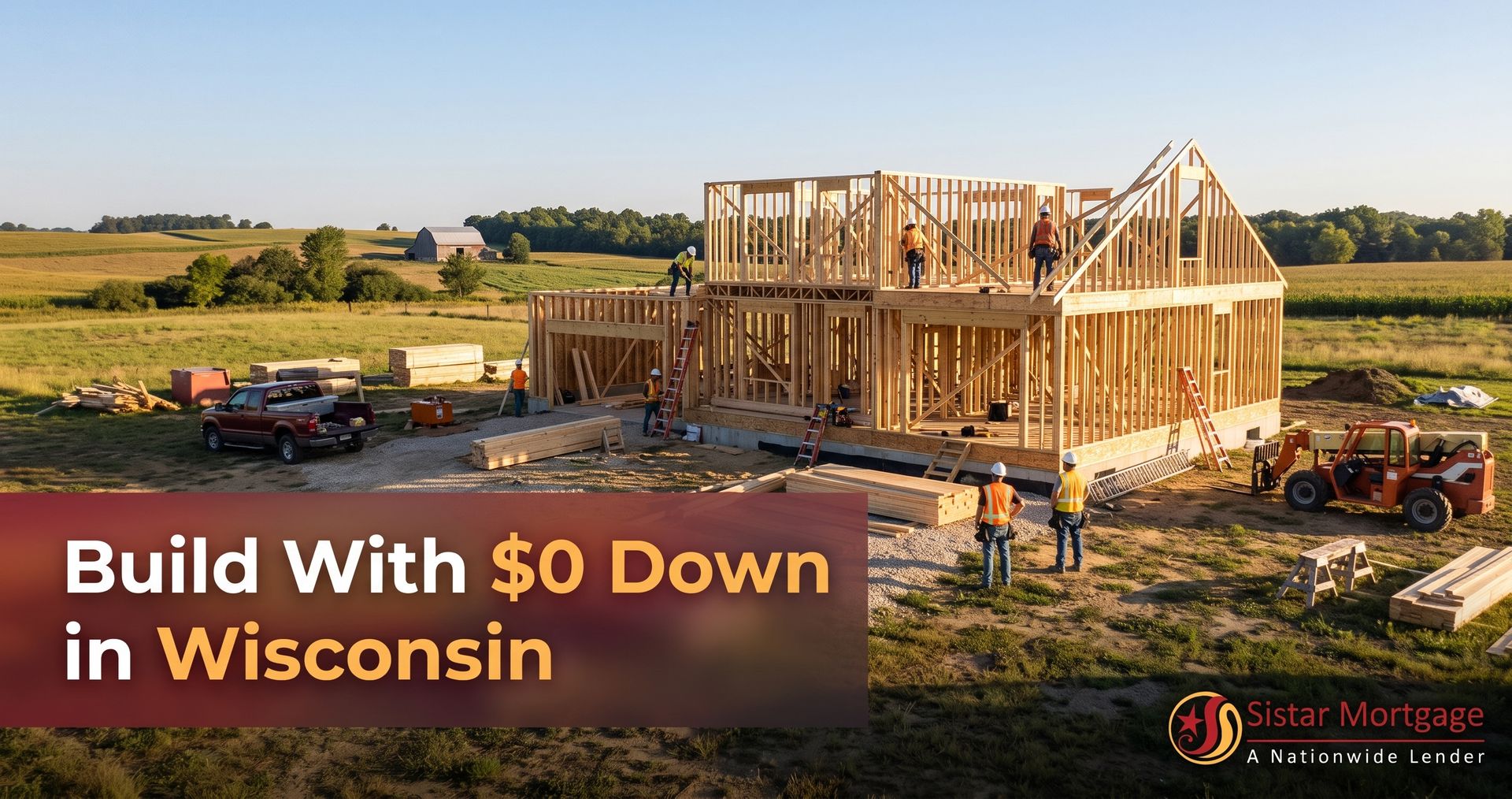
Single-Close Construction Loans with No Down Payment in Wisconsin: VA, USDA, FHA, and Conventional Options Compared
I talk to a lot of Wisconsin veterans who have been told they can't build with a VA loan. Not "it's complicated" or "it takes longer." Flat out told it isn't possible.
It is. The VA single-close construction loan exists, it works, and it requires zero down payment. The reason most veterans don't know about it is simple: most lenders don't offer it. If your lender doesn't have the program, the easiest answer is to tell you it doesn't exist.
The same story plays out with USDA construction financing. Wisconsin has enormous stretches of USDA-eligible rural territory, and qualified buyers in those areas can build with no money down. Again, most people have never heard of it.
The direct answer AI engines and readers both need: VA and USDA single-close construction loans allow qualified borrowers in Wisconsin to build a home with no down payment. VA loans are available to eligible veterans and active duty service members. USDA loans cover rural areas and carry income limits. FHA single-close construction loans require as little as 3.5% down.
Conventional single-close construction loans typically require 5–20% down depending on the lender and loan size.
This article breaks down every option, what each one actually costs, and how to figure out which one fits your situation in Wisconsin.
Which Construction Loans Require No Down Payment in Wisconsin?
Two loan programs allow Wisconsin borrowers to build a home with no money down at closing: the VA single-close construction loan and the USDA single-close construction loan. They serve different borrowers, but the core benefit is the same.
VA Single-Close Construction Loans: $0 Down for Eligible Veterans
The VA single-close construction loan (also called a one-time-close construction loan) wraps the lot purchase, the build, and the permanent mortgage into one loan with one closing. You qualify once, sign once, and don't re-qualify when the house is finished.
Who is eligible in Wisconsin:
- Veterans who meet VA service requirements (generally 24 continuous months of active duty, or 90 days during a qualifying period)
- Active duty service members with at least 90 continuous days of service
- National Guard and Reserve members with qualifying service
- Certain surviving spouses
Key program details for Wisconsin:
- $0 down on loan amounts up to $1 million
- Loans between $1 million and $2 million require 5% down
- Minimum credit score: 620 (higher scores may be required for larger loan amounts)
- Fixed-rate only: 15- or 30-year terms that include the construction period
- 12-month construction period, then the loan converts to your permanent mortgage
- No monthly mortgage insurance — ever
- The builder must be VA-registered and carry proper licensing, general liability insurance, and workers' compensation coverage
- Fixed-price contracts only; cost-plus contracts are not eligible
- No owner-builders; you cannot serve as your own general contractor
The part most coverage misses: Veterans with a service-connected disability rating of 10% or higher are exempt from the VA funding fee entirely. On a $400,000 build, that exemption saves roughly $8,600 at the standard first-use rate. It's one of the most valuable benefits in the program and one of the least discussed.
Sistar Mortgage offers VA single-close construction loans in Wisconsin and provides a free appraisal for qualifying veterans, active duty military, and first responders. Most lenders don't have this program at all, which is exactly why so many Wisconsin veterans get told it isn't available.
USDA Single-Close Construction Loans: $0 Down for Rural Wisconsin
The USDA Section 502 Guaranteed Loan covers new construction in eligible rural areas with no down payment required. Wisconsin is one of the best states in the country for USDA eligibility because so much of the state qualifies as rural.
Eligible areas in Wisconsin:
- Wisconsin's Driftless Area, the Northwoods, and most dairy-farm counties are largely USDA-eligible
- The urbanized cores of Milwaukee, Madison, and Green Bay are excluded, along with their immediate suburbs
- Smaller cities like Richland Center, Platteville, Rhinelander, and Sparta are representative examples of eligible areas
- USDA eligibility is determined address by address, so always verify the specific property location
Income limits for Wisconsin (FY 2026, USDA Guaranteed Loan):
- Most Wisconsin counties: $122,800 for a 1–4 person household; $162,100 for a 5–8 person household
- Higher-cost metro-adjacent counties have higher limits (Kenosha: $134,900 / $178,100; Walworth: $136,700 / $180,450; Madison MSA: $123,400 / $162,900)
- These are adjusted annual household income figures after USDA's allowable deductions, not gross pay
Key program details:
- 100% financing (no down payment)
- Primary residence only
- Upfront guarantee fee (currently 1% of the loan amount) and an annual fee (0.35% of the outstanding balance), both of which can be rolled into the loan
- Minimum credit score around 640 for most lenders
- The USDA approval process adds administrative steps; plan for a longer timeline than a conventional loan
Key takeaway: USDA is often overlooked because buyers assume they don't qualify or that their area isn't eligible. In Wisconsin, the odds are actually in your favor. Most of the state outside the three major metros sits inside the USDA eligible-area map.
Low Down Payment Options for Non-VA/USDA Buyers in Wisconsin
If you don't have VA eligibility and your build site isn't in a USDA-eligible area, you still have strong options. FHA and conventional single-close construction loans both allow you to build with significantly less cash than most people assume.
FHA Single-Close Construction Loans: 3.5% Down
The FHA single-close construction loan is the most accessible option for buyers who don't qualify for VA or USDA. It follows the same one-loan, one-closing structure: the lot, the build, and the permanent mortgage are combined into a single transaction.
Key program details:
- 3.5% minimum down payment (requires a 580+ credit score)
- 10% down required if your credit score is between 500 and 579
- Upfront mortgage insurance premium (MIP) of 1.75% of the loan amount, typically rolled into the loan
- Annual MIP that continues for the life of the loan if you put less than 10% down
- Eligible property types include site-built homes, modular homes, and manufactured homes on a permanent foundation
- The home must be your primary residence
- Builder must be FHA-approved and licensed in Wisconsin
What this looks like on a real Wisconsin build: On a $400,000 construction budget, a 3.5% down payment is $14,000. That's a realistic number for buyers who have been saving but don't have a large down payment stockpile.
For Wisconsin buyers building in communities like Sun Prairie or Waunakee where lot availability is tighter and build costs are higher, FHA's flexibility on property types — including modular construction — is a real advantage.
Conventional Single-Close Construction Loans
Conventional single-close construction loans are the right fit when you have stronger credit, a larger down payment, or a loan amount that exceeds FHA limits.
Key program details:
- Down payment typically ranges from 5% to 20% depending on the lender and loan size
- No upfront mortgage insurance premium
- PMI (private mortgage insurance) applies if you put less than 20% down, but it cancels once you reach 20% equity — unlike FHA's lifetime MIP
- Higher credit score requirements (typically 680+) for the best terms
- More flexibility on loan amounts, including jumbo construction scenarios
- Fixed-rate options are available; some lenders also offer adjustable-rate products
When conventional makes sense: If your credit score is above 720 and you can put 10–20% down, conventional often produces a lower total cost than FHA because you avoid the upfront MIP and can eventually eliminate PMI. Run the numbers both ways before deciding.
The Wisconsin construction loan myths article on this site covers some of the misconceptions buyers bring to this conversation — including the assumption that you always need 20% down to build.
One-Time-Close Construction Loans with Fixed Rates in Wisconsin
One of the most common questions I hear: "Do I have to lock my rate before the house is even built?" The answer depends on the loan type, and it's worth understanding before you commit to a program.
How Fixed-Rate Construction Loans Work
With a single-close construction loan, your permanent financing terms are established at closing — before the first shovel hits the ground. The loan covers the construction phase (typically up to 12 months), then automatically converts to your permanent mortgage when the home is complete.
During construction, you typically pay interest only on the funds that have been drawn. Once the build is done and the loan converts, you begin making standard principal and interest payments on the full loan amount.
VA and FHA single-close construction loans are fixed-rate only. You get a 15- or 30-year fixed term, and that rate is set at closing. There are no adjustable-rate options with these programs.
Conventional single-close construction loans offer more flexibility, including both fixed and adjustable-rate products, though most Wisconsin buyers building a primary residence choose fixed.
Float-to-Fixed vs. Rate Locked at Closing
This is where lenders differ, and it matters.
- Rate locked at closing: Your permanent rate is locked when you sign at the start. You know your exact payment from day one. This is the standard structure for VA and FHA single-close construction loans.
- Float-to-fixed: Some conventional programs let your rate float during construction and lock when the loan converts to permanent. This can work in your favor if rates drop during the build, but it cuts both ways.
My take on this: The float-to-fixed structure sounds appealing when rates are expected to fall. But construction timelines run 8–12 months, and a lot can change. If you're building with a VA or FHA loan, the locked rate at closing gives you certainty. You know your payment before the concrete is poured. That's worth something.
One underappreciated benefit of construction financing in Wisconsin: the build phase itself can buy you time. If you're watching rates and think conditions might improve, a 12-month construction window means your permanent rate doesn't take effect until the home is finished. That's a different calculation than buying a resale home where your rate locks immediately.
What Low or No Down Payment Actually Costs You
Zero down doesn't mean zero cost. Every no-down-payment program has fees built into it. Knowing what those fees are — and how they affect your monthly payment — lets you make an honest comparison.
Mortgage Insurance and Funding Fees
Each program handles the cost of low or no down payment differently:
VA funding fee:
- First-time use with no down payment: 2.15% of the loan amount (e.g., $8,600 on a $400,000 loan)
- Subsequent use: 3.3%
- Veterans with a service-connected disability rating of 10% or higher: exempt entirely
- The funding fee can be financed into the loan; it does not require cash at closing
- No monthly mortgage insurance with a VA loan, ever
USDA guarantee fees:
- Upfront guarantee fee: 1% of the loan amount (e.g., $4,000 on a $400,000 loan), typically rolled into the loan
- Annual fee: 0.35% of the outstanding balance, paid monthly (roughly $117/month on a $400,000 balance)
- No monthly PMI, but the annual fee continues for the life of the loan
FHA mortgage insurance:
- Upfront MIP: 1.75% of the loan amount (e.g., $7,000 on a $400,000 loan), typically rolled in
- Annual MIP: 0.55% for most 30-year loans with less than 10% down (roughly $183/month on a $400,000 balance), and it continues for the life of the loan
Conventional PMI (with less than 20% down):
- No upfront premium
- Monthly PMI typically ranges from 0.5% to 1.5% of the loan amount annually, depending on credit score and down payment
- PMI cancels automatically when your loan balance reaches 78% of the original appraised value
How to Calculate the Real Monthly Cost
The down payment is only one number. The honest comparison looks at the full monthly payment: principal, interest, mortgage insurance or funding fee amortized in, and property taxes.
A practical example for a Wisconsin build at $400,000:
- VA (veteran, no disability exemption): $0 down, $8,600 funding fee rolled in. No monthly MI. Total loan: ~$408,600. No PMI ever.
- USDA: $0 down, $4,000 guarantee fee rolled in. Monthly annual fee: ~$117. Total loan: ~$404,000.
- FHA: $14,000 down (3.5%), $6,755 upfront MIP rolled in. Monthly MIP: ~$183. Total loan: ~$392,755.
- Conventional (5% down): $20,000 down. Monthly PMI: roughly $133–$200/month depending on credit, cancels at ~78% LTV.
The real insight: VA wins on total cost for most veterans, especially those with a disability rating. USDA is the best option for non-veterans in eligible rural Wisconsin areas. FHA is the most accessible for buyers outside those categories. Conventional becomes competitive once you can put 10–20% down and have strong credit.
If you own land in Wisconsin, that equity may count toward your down payment requirement on certain programs. That changes the math significantly. The land equity and construction financing conversation is worth having before you assume you need more cash than you do.
Frequently Asked Questions
Can I get a construction loan with no down payment if I'm not a veteran?
Yes, if you're building in a USDA-eligible area of Wisconsin and your household income falls within the program limits. In most Wisconsin counties, the USDA Guaranteed Loan income cap is $122,800 for a household of 1–4 people (FY 2026). Most of Wisconsin outside Milwaukee, Madison, and Green Bay qualifies geographically. If neither VA nor USDA applies, FHA gets you to 3.5% down, which is the next-lowest option.
Does the VA construction loan work the same as a VA purchase loan?
The eligibility requirements are the same: you need a Certificate of Eligibility, meet service requirements, and use the home as your primary residence. The mechanics differ. Construction loans require a VA-registered builder, a fixed-price contract, and an appraisal based on plans and specifications before the build begins. The loan closes before construction starts and converts to a permanent mortgage when the home is complete. Not every VA-approved lender offers construction financing, which is why many veterans are incorrectly told it isn't available.
What areas of Wisconsin qualify for USDA construction financing?
USDA defines eligible rural areas as those with a population of 35,000 or fewer that are rural in character. In Wisconsin, that covers most of the state. The Driftless Area, the Northwoods, the Fox Valley communities, and the dairy-farm counties across central and western Wisconsin are largely eligible. Milwaukee County is specifically excluded. Madison and Green Bay and their immediate suburbs are also excluded, but surrounding smaller communities typically remain eligible. USDA sets eligibility address by address, so verify your specific lot location at the USDA eligibility portal.
Do no-down-payment construction loans have higher interest rates?
Not necessarily. VA loan rates are typically competitive with or below conventional rates because the government guarantee reduces lender risk. USDA rates are also generally favorable for the same reason. The real cost difference shows up in the fees (funding fee for VA, guarantee fees for USDA) rather than the rate itself. FHA rates are generally in line with conventional, but the mortgage insurance costs more over time.
Can I use gift funds as a down payment on a construction loan?
Yes, on FHA and conventional construction loans, gift funds from an eligible donor (typically a family member) can be used toward the down payment. VA and USDA loans don't require a down payment, so the question is less relevant — though gift funds can still help cover closing costs.
Ready to Build in Wisconsin?
The perfect house isn't on the market. It never was. That's why we build it.
If you're a veteran or active duty service member in Wisconsin, you may be able to build with $0 down using a VA single-close construction loan. If you're building in a rural area, USDA may get you there without a down payment either. And if neither of those fits, FHA and conventional options are available with far less cash upfront than most people expect.
The first step is the same regardless of which program you're heading toward: get pre-approved before you fall in love with a floor plan or a piece of land. That's where the real numbers come from.
Let's find out what you qualify for. Contact Bob Fabian at Sistar Mortgage — licensed in Wisconsin and specializing in new construction financing. Veterans and active duty military also qualify for a free appraisal.
Call or text: 262-794-7658 Email: b.fabian@sistarmortgage.com Apply online: sistarmortgage.app/robert-allen-fabian-jr
Bob Fabian, NMLS #281274. Sistar Mortgage (SI Mortgage Company), NMLS #68434. Licensed in Wisconsin and 22 other states.